“Remember the Sabbath day, to keep it holy. Six days you shall labor and do all your work, but the seventh day is a Sabbath to the Lord your God; on it you shall not do any work...”
It has been thousands of years since the Jewish people were given this commandment. The elevator, on the other hand, has existed for only about a hundred and fifty years. Times changed, the world started building upward, and a problem arose that somebody had to solve.
The most Israeli invention there is
The Shabbat elevator is, not very surprisingly, an original Israeli invention. The first one was designed and developed by engineer David Benet in the mid-1970s for Shaare Zedek Hospital in Jerusalem, following the guidance of Rabbi Levi Yitzchak Halperin, who headed the Institute for Science and Halacha. Rabbi Halperin, by the way, did not take the matter lightly. He researched the issue for about sixteen years before publishing his major book on the subject (called, what else, "Elevators on Shabbat").
A need that became an invention in one Jerusalem hospital very quickly turned into a real demand in tens of thousands of buildings across Israel. Like any other technology, this one developed and improved over time. Until recently, a Shabbat elevator could only be installed in an elevator with a machine room. In recent years, solutions have also been developed for MRL elevators, the ones without a machine room, which have become the standard in most new buildings today.
Don't know what a machine room is? Read our article on elevator types 😉
So what exactly is a Shabbat elevator?
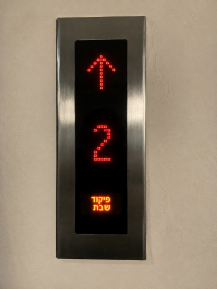
In short? It isn't a special elevator. It's actually completely ordinary.
The only difference is software. The elevator has a feature installed called "Shabbat control", which is really a different operating mode of the same elevator you ride all week. When this mode is turned on, the elevator stops waiting for commands and starts working according to a fixed, pre-set program.
The engineering principle behind it is simple and elegant: cut off the passenger's influence on the elevator. You don't press anything, you don't choose a floor, you don't call the elevator. You just get in, and everything else happens by itself.
How it works, step by step
First of all, how is it turned on at all? Contrary to what you might think, the elevator doesn't "know" when Shabbat begins. Someone on behalf of the building committee has to set the Shabbat clock, because the time Shabbat begins changes from week to week. Activation itself can happen automatically, through the Shabbat clock, or manually, through a key or dedicated switch on the control panel. That's useful, for example, on holidays.
Once Shabbat control is active, the elevator behaves completely differently:
- It moves between floors automatically, on a fixed schedule, without anyone calling it.
- It stops at pre-set floors, waits a few seconds for passengers to get in, and then continues.
- Before the doors close it sounds a short buzz, so you know to step away from them.
- The buttons in the car and on the landings are disabled, so even if you press them by mistake, nothing happens.
The floors where the elevator stops are set in advance by the technician during setup, not at random. This is an important point that leads straight to the next question, which is of course:
Wait, does it really stop on every floor?
Well, not necessarily.
It's commonly thought that a Shabbat elevator has to stop on every floor on the way up and on the way down, but that isn't accurate. The technician can set it to stop on every floor, or on every second floor, depending on the building's needs. What's more, in 2023 a court ruling even held that a Shabbat elevator in a high-rise building doesn't have to stop on every floor, partly because of the hardship and delay such a ride involves. So if you thought you were doomed to stop seven times on the way to the eighth floor, you'll be glad to know that isn't necessarily the case.
Can any elevator be used as a Shabbat elevator?
This is where it gets interesting, and also where the differences between elevators begin. In principle, Shabbat control can be added to almost any elevator, but the "kashrut" of that control depends on the subtle things that happen deep inside the system.
Modern elevators are full of smart sensors. There is an electronic eye that makes sure the door doesn't close on you, and a weighing mechanism that measures how much weight is in the car. On weekdays, all of this is great. On Shabbat, it's exactly the problem, because if your entering the elevator "does" something that changes how the system operates, a halachic problem may arise, since your presence in the elevator affected a mechanism in the elevator that performs work.
So to make an elevator fit for Shabbat, these sensors need to be disabled or adapted, and that isn't always simple, especially in new, sophisticated elevators with electronic weighing systems. For this reason it's important that the elevator company deeply understands the technical side, which sometimes simply doesn't allow it, the halachic side and its requirements, and of course the building management's requirements as well.
The halachic side: why it's permitted, and why some have reservations
This is the heart of the matter, so it's important to say one thing clearly at the start: we are an elevator company, and we're really good at it. When it comes to halachic rulings and deciding between different rabbis, we understand less. What we can do is lay out the picture clearly, so you know what exists and can go on to ask your own rabbi.
The central halachic idea is that if the elevator runs by itself, according to a program set before Shabbat began, and the passenger doesn't trigger any forbidden work when getting in or out, then in the view of a large share of halachic authorities there is no desecration of Shabbat here.
The two main schools
For decades there have been two main approaches, and two institutes that accompany them:
The Institute for Science and Halacha
The approach of Rabbi Halperin, the stricter one. It is concerned that even an action caused by a person's weight could be considered their act, so it adapts the sensors to work on the principle of "removing the preventer", a halachic principle under which the action is considered to happen by itself, with no forbidden work at all.
The Tzomet Institute
Relies on the rulings of Rabbi Shlomo Zalman Auerbach. A more lenient approach, whose position is that anyone may use a Shabbat elevator from the outset, not only someone who is ill or elderly, because using it involves no forbidden act.
Who permits it
The Shabbat elevator received the approval of very important halachic authorities. Those who permitted it include Rabbi Shlomo Zalman Auerbach, Rabbi Ovadia Yosef, Rabbi Yitzchak Yaakov Weiss and Rabbi Neuwirth. Rabbi Ovadia Yosef, for example, ruled that by the letter of the law it is permitted to use an automatic elevator on Shabbat, both going up and going down, especially where there is a need, such as for an elderly person, someone ill or a woman after childbirth.
And who has reservations
On the other hand, the permission isn't accepted by all halachic authorities. Some forbade it, usually not because of actual forbidden work, but for reasons such as disrespecting the honor of Shabbat, "weekday activity" (uvdin d'chol), or concern that it opens a loophole. There are also interesting middle positions: some permit riding the elevator up but recommend being stricter going down, and some avoid it altogether. Even among those who permit it, there are authorities who personally refrain.
The practical bottom line is simple: there is a range of opinions, and everyone follows their own rabbi and community. So when a Shabbat elevator is installed, a method and a halachic authority are chosen to suit the community that will use it.
What the law says
Alongside halacha there is also Israeli law, and it's important for the building committee and residents to know it. Here are the main points:
2001 A law was passed requiring that in a new residential building with more than one elevator, the seller of the apartments must provide at least one elevator with Shabbat control.
2011 It was set that in a building with more than one elevator in which Shabbat control is already installed, a request from a single resident is enough to operate it as a Shabbat elevator. In a building with only one elevator, the consent of a majority of the apartment owners is required.
Adding it in an existing building To add Shabbat control to an elevator in an existing building, the consent of a majority of the apartment owners is required. The cost of installation is shared among all the apartment owners according to floor area, while the ongoing operating cost is borne by those who asked for it to be operated.
What hours does it run, and how is it turned on?
As we saw, someone on behalf of the committee sets the system in advance, so on Shabbat itself there is usually no need to touch anything. The operating hours are set by the residents, but if there is no other agreement, the law sets a default for residential buildings with two or more elevators:
- On Friday night and holiday eve: from the start of Shabbat, for about four hours.
- On Shabbat morning: from seven in the morning until half past twelve.
- Toward the end of Shabbat or the holiday: about three more hours.
In a building with only one elevator, the operating hours are set by a majority of the apartment owners, taking into account all users and their needs. These are, of course, defaults, and each building can adjust the hours to suit its residents.
A Shabbat elevator in a shared building, when everyone lives together
There is of course also a social, interpersonal side. In many buildings in Israel, religious and secular people, those who keep Shabbat and those who keep it less, live together and all share the same elevator. A Shabbat elevator can create tensions in a building that are worth knowing about in advance, because most of them can be resolved through coordination and conversation between residents.
On the one hand, a Shabbat elevator travels even when nobody called it, is slower, stops at floors that may not be needed, and buzzes before the doors close. All of this can bother some residents, and it also increases wear on elevator components, especially the doors, which open and close much more often.
On the other hand, and this is the beautiful part, a Shabbat elevator is exactly what allows different people to live in the same building instead of splitting into separate enclaves by lifestyle. There is a famous story about Rabbi Elyashiv, who was asked whether a sign should be hung reserving the Shabbat elevator only for the sick and the elderly, so that people wouldn't use it too much. His answer was simple: there's no need for any sign. Whoever doesn't need it won't ride it anyway, and whoever rides it probably has a need.
Our service areas also include towns and cities with a large Haredi population, including Bnei Brak and Elad, where a Shabbat elevator is of course an integral part of the building and not just an add-on. We know our customers' special needs well, and how important it is for a Shabbat elevator to work exactly as it should, every single week.
How much it costs, and what happens with kashrut over time
The cost of adding Shabbat control varies a great deal depending on the type of elevator, the work specification, and also the number of stops, meaning the number of floors where the elevator stops. Generally speaking, adding Shabbat control to an existing elevator starts at around a few thousand shekels and goes up according to the height of the building and the work required.
There is a big difference between installing it in a new elevator and in an existing one. In a new building, when the elevator is planned in advance with Shabbat control, the addition is relatively cheap. When adding it to an existing elevator, on the other hand, it is sometimes necessary to lay new infrastructure in the shaft, adapt the button panels, update the controller and make changes to the doors. More work, more cost.
A point many people miss: kashrut isn't "one and done"
And this is a very important point: from the moment a Shabbat elevator is installed, nothing guarantees by itself that it stays kosher over time. A replaced component, a software update, or even careless handling by a technician who doesn't know the subject can affect the Shabbat control settings without anyone noticing.
That is exactly why it's important for the elevator to be checked regularly according to the instructions of the halachic authority that approved it, and not only in the regular periodic engineering inspection done every six months. Today there are even systems that continuously monitor the elevator's kashrut and alert you if something has changed.
If you're thinking of adding Shabbat control to your elevator, or simply aren't sure whether the existing elevator is set up and maintained properly, this is exactly the kind of thing you can consult with us about. We'll be happy to explain, advise, and help the committee find the right solution for the building and its residents.
Frequently asked questions about Shabbat elevators
What do you do if you get stuck in a Shabbat elevator on Shabbat?
Does the alarm button work in Shabbat mode?
Can the doors close on me if the sensors are disabled?
Is a Shabbat elevator more dangerous than a regular elevator?
Does a Shabbat elevator stop on every floor?
Can any elevator be turned into a Shabbat elevator?
How much does it cost to add Shabbat control to an elevator?
Who decides in a building whether a Shabbat elevator is installed and operated?
In summary
The Shabbat elevator is a beautiful example of how a bit of Israeli thinking solves an ancient problem with technology. It isn't a different elevator, but the same elevator that knows how to work on its own, and above all it is what allows different people to share the same building, the same entrance and the same elevator, each in their own way.