There are things in life nobody thinks about while they're working. The electricity, the water, the fridge. The elevator is one of them. It serves your building a few hundred times a day, saves you long minutes of sweat and effort on the stairs, and as long as it's working, nobody gives it much thought.
The one thing standing between another ordinary day, where you ride up to the eighth floor with the groceries in half a minute, and a day that can turn very unpleasant, with plenty of running up and down stairs and calls to the building committee, is a good elevator service company.
In many cases building committees sign the first service contract they are offered, without really understanding all the implications and the "fine print" of that contract. Then they suddenly discover that the service they actually get is, to put it gently, not quite what they expected.
So before you sign, we've gathered here everything worth knowing: what an elevator service contract actually is, what types of contracts exist, what they include, how much it costs, and how to switch companies without paying twice. Let's start with the basics.
What exactly is an elevator service contract, and what does it include?
A service contract is an ongoing agreement between the building and a licensed elevator company. Broadly, it says something very simple: you pay a fixed fee, and the company makes sure the elevator works. But as always, there are plenty of small details here worth knowing. So what does a service contract usually include?
- Periodic maintenance visits, usually once every month or two, including preventive servicing, a general inspection, lubrication, adjustment, cleaning and handling of normal wear.
- Handling breakdowns during the company's regular working hours.
- Rescuing passengers from the elevator, 24 hours a day, including Shabbat and holidays.
- Preparation for the periodic certified inspector's inspection, and handling the "elevator inspection report" issued until it is "clean".
- Proper written documentation of every visit and service call, stating what was actually done.
As for payment, the service fee is usually set as an annual sum divided into quarterly payments, index-linked and plus VAT. The contract is usually signed for one year, renews automatically, and can be exited with about three months' written advance notice.
And it's important to know: some things stay the building's responsibility, not the company's. Ordering a certified inspector once every six months and paying for it, locking the machine room, insuring the elevator, a Bezeq line or SIM card for the elevator, and reporting faults immediately. And above all, by law the overall responsibility for the elevator's soundness and safety rests with the building committee and the property owners. Hiring a service company hands off the actual work, but it does not remove your responsibility to make sure that work is really being done.
A service contract is mandatory, not optional!
Elevator maintenance is not a matter of choice. Under the Supervision of Commodities and Services Order (Installation of Elevators and Provision of Services to Elevators), 5744-1984, every building with an elevator must maintain three things: a certified inspector's inspection once every six months, an active contract with a licensed company, and orderly documentation of every service call.
And the word "licensed" here is not just for decoration. A licensed company meets strict regulatory requirements, holds an "elevator service company" license under which the law permits it to provide the service, and undergoes periodic inspections. Make sure you work only with a licensed service company! This is really not a place to compromise, and anything else is simply illegal.
The bottom line is simple: your decision is not whether to hire a service company, but which service company to hire.
Three types of contract — what's the difference?
At almost every elevator service company you'll find two plans, and the difference between them is simple: who pays for the work and the parts when they're needed. Think of it like car insurance: you can pay a little more every month and sleep soundly knowing everything is covered, or pay less and take on the cost of the expensive parts yourself when they need replacing. But we also have a third plan. We realized our customers needed another option, one that completely removes the risk of a very high, unexpected expense for the building: Diamond Cover.
Let's go through all three and see exactly what each one means:
Basic Contract
Includes routine maintenance, periodic inspections and handling minor faults that don't require replacing components. Parts, and the work of replacing them, are billed separately as needed. Every time a repair is required, a formal quote is sent to the building committee, and the work begins only once it has been approved. The monthly price is lower, in exchange for the risk that an expensive part will fail, and for the fact that every job needs the committee's written approval before it can be carried out.
Comprehensive Contract
Covers almost everything: routine maintenance, fault handling, preventive servicing, and also most of the wear parts and components and the work on them. This contract does not include large, expensive parts that wear out only rarely. Faults are dealt with behind the scenes and don't require committee approval, which means the monthly price here is far more stable and predictable, and the workload on the committee and the residents drops significantly.
Diamond Cover
And here's where the difference comes in. Diamond Covers even the largest and most expensive components, the ones almost every comprehensive contract on the market excludes, such as the hoisting machine, the controller, the control panel, suspension ropes and others. Everything is included. Even if a component worth tens of thousands of shekels needs replacing, you won't get a bill from us. It's a premium product that's rare in Israel, built specifically for customers who want complete certainty about the cost and zero hassle with their elevator company.
What isn't covered, even in a comprehensive contract
This is the part of the contract that's really worth reading carefully before you sign. Even a comprehensive contract, one that covers parts and repairs, almost always includes a list of exclusions, and on it you'll find the largest and most expensive components in the elevator. That's legitimate and very common in the industry, and the purpose of these exclusions is fair enough: they allow for correct pricing that doesn't get too expensive for the customer, and they make it clear what's included and what isn't. But you need to know what's on that list, because the difference in cost between a "small" component and a major one can be enormous.
These are the components you'll most often find on the exclusions list:
Alongside those, vandalism damage, power outages and water damage are usually excluded as well. There is a big difference between a contract that excludes only the small extras and a contract that excludes the heart of the elevator itself. That is why the most important rule before you sign is simple: Ask to see the full list of exclusions, and read it. A transparent company will be happy to show you exactly what is covered and what is not. If they start stammering when you ask, that is an answer too.
One important note: all of these exclusions apply to the comprehensive contract. On the Diamond plan those major components actually are included, and that is exactly what makes it so sought after.
And what about the price?
With us a basic service contract starts at around ₪600 a month, and can reach several thousand shekels for taller or more complex elevators. The final price for each building depends on the type of elevator, its age, its condition, its size and the number of floors in the building. A new elevator in a small building and a thirty year old elevator in a high rise tower are two different worlds, and that shows up in the price.
And when you compare prices, look at the big picture. Is the contract you were offered basic or comprehensive? Which parts are excluded? Is the company you are signing with well known and reliable? Will it know how to give your particular elevator the right service, or will you end up disappointed? Very often, going with the cheapest option turns out in hindsight to be a mistake that costs you both time and money.
It is also important to understand that there is a significant price difference between the three coverage plans, and that makes sense, because they cover completely different things. A major part such as replacing the suspension cables can cost close to₪100,000, and on the Diamond plan a cost like that is already included. The broader the coverage, the higher the monthly price.
You are not tied to anyone!
Many building committees think they are stuck with the company that installed the elevator, or with the company that has always been there. You are not. You are entitled to choose any licensed service company, and to switch at any stage, subject to the terms of your existing contract. What is more, the law states that in a contract signed for more than a year, the building committee has the right to terminate it at any time after the first year. Usually all you need to do is give written notice, around three months in advance.
And this is exactly where a situation can arise that "blocks" the move to another company: people do not want to pay two companies at the same time during the notice period. So here too we will meet you halfway: in most cases Korsia Elevators will waive the payment for your first months with us, so you can quietly see out your commitment to the previous company without paying twice. As far as we are concerned, moving to us is an upgrade, not a penalty.
What separates a company that actually repairs from a company that just "gets the elevator working again"
We hear about service companies where the technician comes to the building, gives the door a little kick, gets the elevator running again, and disappears. A week later the same fault comes back, and with it another call, another payment, and another stuck resident. They treat the "symptoms" but not the "disease". We prefer to diagnose properly, get to the root of the problem, and cure it. It may take more than one visit, but in the end it saves you a lot of time and money.
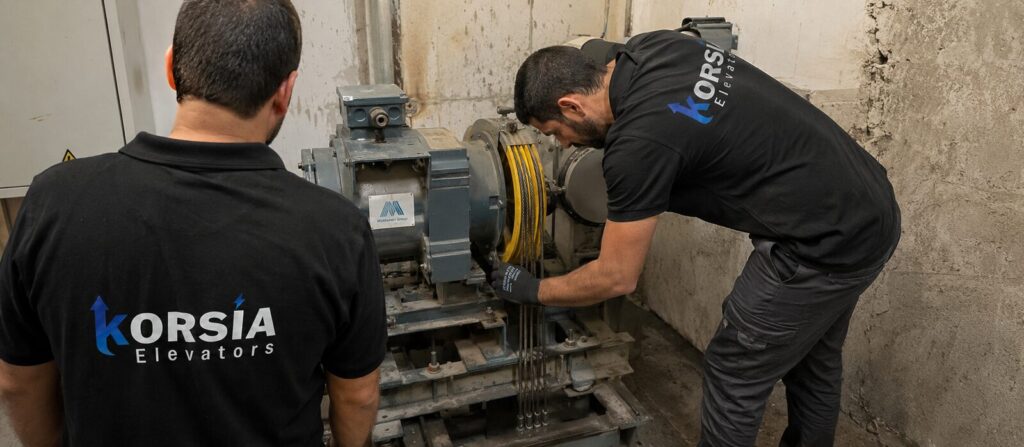
Beyond that, these are the things worth checking with any service company, ours included:
The team that shows up is ours, not some subcontractor picked up along the way. The same team that knows your elevator comes back every time, rather than learning it from scratch at your expense.
Response time and location. This may be the most practical factor of them all. We are strategically located in the heart of the central region, and that translates into very fast response times. From our warehouse we get quickly to Kiryat Ono, Ganei Tikva, Yehud, Or Yehuda, Givat Shmuel and Petah Tikva. When the elevator is stuck, the difference between half an hour and three hours is the difference between night and day for you, and for the whole building.
Access to parts, in advance. One of the first things we do behind the scenes on your behalf is stock our warehouse with parts for your specific elevator. That way, when something happens, in most cases the part is already in our hands.
Professionalism and transparency. Licensed certified technicians, original parts, and a proper report after every visit. You always know what was done to the elevator, and when.
What to ask before you sign
- What exactly is included in the contract, and what is excluded from it?
- Is it a comprehensive contract that includes spare parts, or a basic contract where parts are charged separately?
- What is the estimated response time for emergency call-outs, and are you located close to us geographically?
- Are the technicians company employees, or subcontractors brought in ad hoc?
- What is the notice period for terminating the contract?
- What happens when a part that isn't covered needs replacing?
- Do you keep parts for my elevator in stock, or order them each time?
Questions building committees ask us
Is an elevator service contract mandatory?
Comprehensive, basic or Diamond, which is better?
What is Diamond Cover?
Can you switch elevator service companies?
How much does an elevator service contract cost?
What is usually not included in a service contract?
Do you take on elevators outside your service areas as well?
We'll come to the building, inspect the elevator, and put together a clear quote for you
No cost and no obligation. Fast service across the entire central region, starting at ₪600 a month. You're also welcome to just call and ask, we love talking about elevators. 🤓