We all know that moment. You step into the elevator, press the button and you are about to set off. The doors close. Then suddenly there is an odd noise, a small jolt, and everyone inside freezes for a second. Nobody says a word, but everyone is thinking the same thing. The elevator starts to move and everyone just hopes it will pass without incident.
The truth? It (almost) always does. But in the back of every one of our minds there are a few fears and questions we have never asked out loud. So let us answer them, bust a few myths, get to know the elevator a little more closely, and quieten that small voice that pipes up every time the doors close.
So… can an elevator really fall?
It is the biggest fear any of us has, so let us start there. And the answer is reassuring: it is almost impossible.
And that is not thanks to any single thing, but to layer upon layer of protection.
First, the elevator does not hang from a single cable but from several steel cables, each one of which can hold the car and everyone in it up to the permitted load, with a further safety margin on top of that.
Second, there are brakes, and they work in a particularly clever way: as long as electricity is flowing through the system, it is the current that holds them released so the elevator can move. The moment there is a power cut, or an emergency, the brakes engage automatically. In other words, a power cut actually stops the elevator where it is; it does not release it.
Third, there is a speed governor, a device that constantly makes sure the elevator does not exceed the permitted speed. If it detects an overspeed, it triggers a mechanism called a "safety gear", which physically grips the guide rails and brings the car to a stop on the spot.
And if, somehow, all of these failed at once, a shock absorber is waiting at the bottom of the shaft. In other words: all those action films where the elevator plunges twenty floors? Hollywood made that up.
Can you suffocate from a lack of oxygen if the elevator gets stuck?
No. An elevator car has never been a sealed box.
It has gaps and openings around the doors, and air flows in and out all the time. Even if the ventilation system breaks down, enough air still gets in. The real risk of suffocating in astuck elevator isn't a lack of oxygen, but what the person stuck with you had for lunch, or whether they put on deodorant today.
What happens if the elevator is overloaded? Will the cables snap?
Here too, the answer is no.
Elevators have a load sensor that detects when there is more weight in the car than the elevator is rated to carry. In that situation the elevator simply refuses to move and starts beeping, until someone steps out. And this isn't only found in new elevators, older elevators have overload protection too, just of the mechanical kind.
So an overloaded elevator doesn't fall. It just stands there, waiting patiently for you to decide who is in the least hurry and doesn't mind stepping out to wait for the next one.
How long can you really survive in a stuck elevator?
Far, far longer than you imagine. This isn't a survival film.
You are far more likely to be bored to death than to be in any real danger. And it's worth remembering: you are not alone in there. The emergency bell button inside the elevator connects you to a call centre or to a rescue technician, who can even talk to you while you're still inside the car.
Someone will be sent out to you, and usually within 40 to 50 minutes the rescue technician is already in the building, depending on the time of day and where you are, and sometimes much sooner. So instead of panicking, make yourself comfortable. It will all be over long before your phone battery runs out.
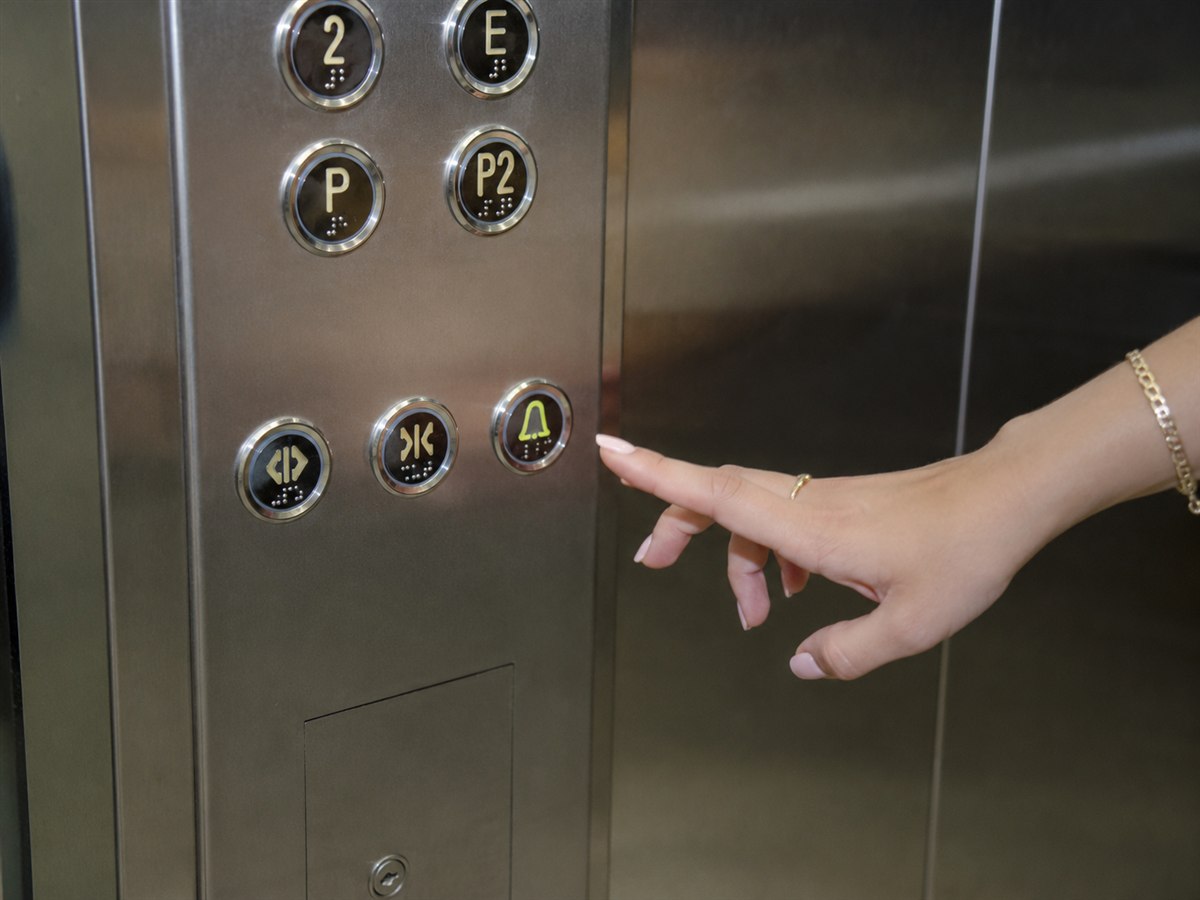
The emergency button inside the elevator car. It connects you with someone who can help
Can a elevator travel with the door open?
In a properly working elevator? Absolutely not.
One of the most basic safety principles is that a elevator does not move until the doors are closed and locked. If the door is open, the elevator simply won't travel.
That is exactly the difference between a properly maintained elevator and a neglected one. When the systems are working, they protect you without you even noticing.
Why do you feel a little "drop" in your stomach when the elevator starts going down?
It isn't a fall, it's rapid acceleration.
As the elevator begins to accelerate downwards, your body feels momentarily lighter, and that is the same small weightless sensation that tickles your stomach. The brain translates it as a "fall", but in practice you are simply accelerating downwards in complete safety.
Incidentally, the newer and more sophisticated the elevator, the weaker that sensation becomes. Modern controls allow much smoother acceleration and deceleration, so the ride feels almost perfectly smooth.
Why do your ears pop in a tall building?
For exactly the same reason it happens on a plane: a change in air pressure.
When you travel up or down a lot of floors quickly, the pressure around you changes, and your ears "block" until they equalise with it. The solution is the same too: swallow, yawn, or simply chew gum on the way to the 40th floor.
I'm stuck! Should I force the doors open and climb out?
No, no, and a thousand times no.
It might look good in the movies, but it's exactly how people actually get hurt. There are two reasons for this. The first is a direct physical danger: the car isn't necessarily lined up with a floor opening, and if you climb out you could fall into the shaft or get trapped between the car and the wall. The second connects to what we said earlier, a elevator with an open door sometimes simply won't move, and that can actually make the standard rescue harder rather than helping it.
So what should you do? Stay calm, press the emergency button, and wait for the professionals. That's the safest route, and it's also the fastest.
But what if every single mechanism really did fail? Is it worth jumping just before you hit the ground?
It is a question we have been asked more than a few times. Picture the unbelievable scenario: every cable snaps at once, the safety gear fails, the brakes give up, the power goes down, and every law of probability in the universe decides to take the day off. The elevator is falling. You have one second. You jump upwards right before impact, and you are saved?
Scientists have actually looked into this, and the answer is: no. It will not help.
First, there is no way to time such a jump; you cannot know exactly when the impact will come. Second, even if your timing were perfect, the speed of your jump is tiny compared with the speed of a falling elevator. And third, in free fall you are floating weightless anyway, so there is nothing to push off from in the first place.
But here is the good news: you will almost certainly never have to find out for yourself. The whole scenario is a movie fantasy, not reality. And the best way to make sure it stays that way is simple: a well-maintained elevator, in the hands of a reliable service company that makes sure none of these things ever happen.